IT Staff Augmentation vs Outsourcing vs In-House Hiring: A Practical Decision Guide
Your product roadmap has more work than your team can handle. A launch date is fixed. A specialist skill is missing. The obvious answer is “we need more developers,” but how you add them matters as much as how many.
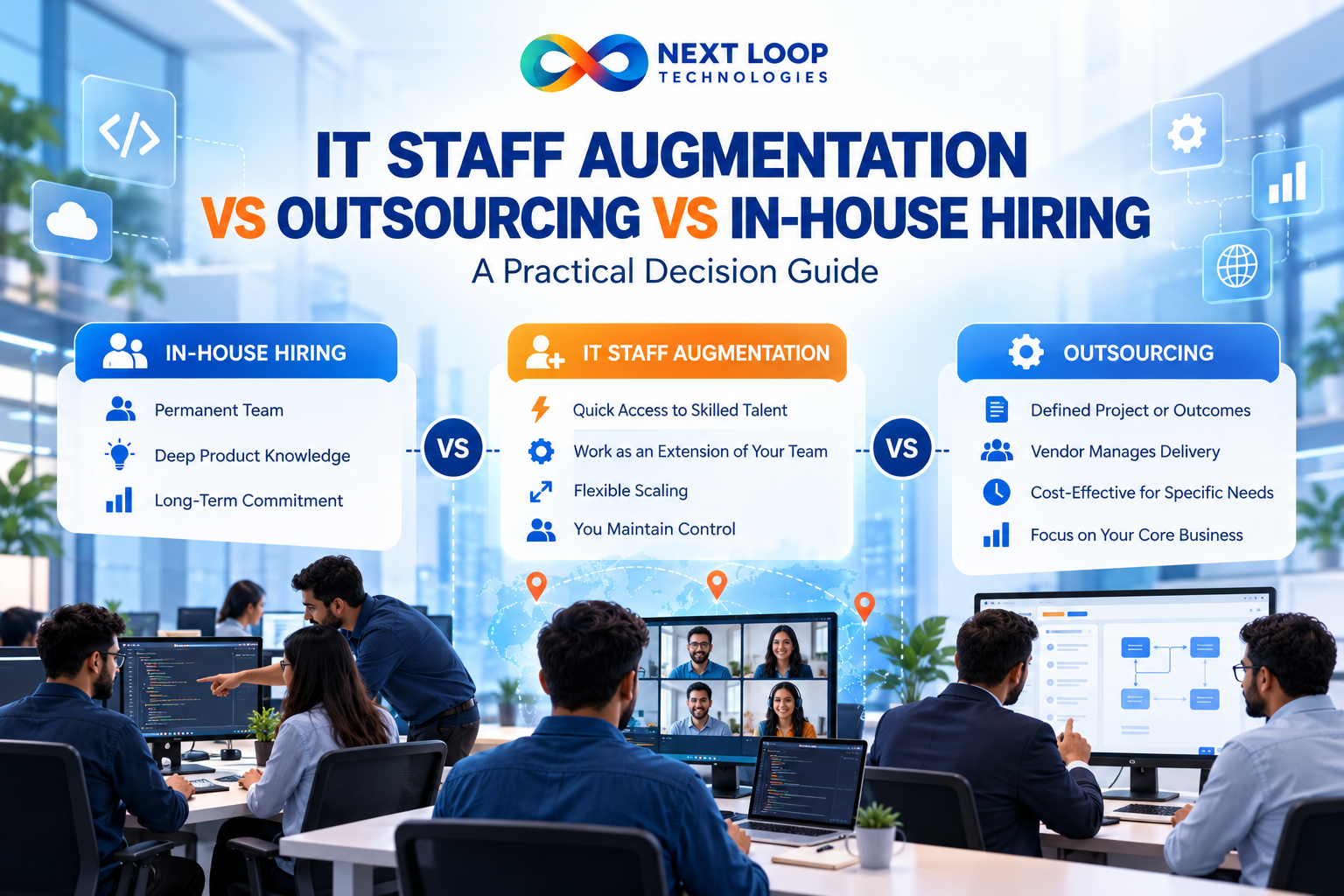
There are three common routes: hire permanent staff, bring in augmented developers to work alongside your team, or outsource a project to an external vendor. Each shifts cost, control, and risk in different ways. This guide explains how they differ, when each fits, and what to check before committing.
The three models in plain terms
In-house hiring. You recruit employees. They join your company, learn your product deeply, and stay for the long term. You carry recruitment, salary, benefits, and management.
IT staff augmentation. An external provider supplies skilled professionals who work as an extension of your team. You direct their day-to-day work, set priorities, and integrate them into your processes. The provider handles sourcing and often administrative matters, depending on the agreement.
Outsourcing. You hand a defined project or function to an external company, which manages delivery with its own team and process. You agree on outcomes and timelines, but you don’t manage the individuals.
The key difference is who manages the work. In-house and augmentation: you do. Outsourcing: the vendor does.
When in-house hiring is the right choice
Permanent hires suit work that is central, ongoing, and benefits from deep context:
- Core product development that will continue for years
- Roles requiring close alignment with company culture and strategy
- Knowledge that would be costly to lose
- Stable, predictable demand for the skill
The trade-offs are time and commitment. Hiring takes months in competitive markets, and it’s hard to scale down if demand drops.
When IT staff augmentation makes sense
Augmentation fits when you need capacity or skills quickly and want to retain control:
- A project peak. You need extra hands for a release, migration, or deadline.
- A skill gap. You need expertise in a specific technology that you don’t need permanently.
- Faster ramp-up. You’d rather not wait through a long recruitment cycle.
- Flexible scaling. You want to add or reduce capacity as the roadmap changes.
- Preserving your process. You have working engineering practices and want new people to follow them.
Many businesses researching IT staffing solutions are in this position: the team and process are sound, but capacity or a particular skill is short.
Augmentation does require management capacity on your side. Someone must assign work, review code, and answer questions. If nobody has time to do that, added developers may produce more coordination overhead than output.
When outsourcing is the better fit
Outsourcing works best when the project is well-defined and you’d rather buy an outcome than manage people:
- A self-contained product or module with clear requirements
- No internal technical leadership to direct developers
- A need for a complete team (design, development, testing) without building one
- A preference for fixed scope and milestones
The trade-off is reduced day-to-day control and a greater need for clear specifications and contract terms. Changes to scope typically require formal change handling.
Side-by-side comparison
| Factor | In-house | Staff augmentation | Outsourcing |
| Who manages the work | You | You | Vendor |
| Speed to start | Slow | Faster | Fast to moderate |
| Control over process | Full | High | Limited |
| Flexibility to scale | Low | High | Moderate |
| Product knowledge retention | High | Depends on handover | Depends on documentation |
| Management effort required | High | Moderate to high | Lower |
| Best for | Core, long-term work | Capacity and skill gaps | Defined projects |
Did you know?
In his 1975 book The Mythical Man-Month, Fred Brooks argued that adding people to a late software project tends to make it later, because new people need time to learn the system and increase communication overhead. The idea, known as Brooks’s law, is a useful caution: staff augmentation works best when onboarding is planned and the work can be divided clearly.
Expert insight
The best predictor of a successful augmentation is rarely the provider’s pitch. It is the client’s readiness: clear priorities, a named technical lead, accessible documentation, and a working code review process. Teams that fix these first get value from augmented developers in weeks. Teams that don’t often blame the developers for problems that existed before they arrived.
What to check before signing an augmentation agreement
- Skills and screening. Ask how candidates are assessed and whether you can interview them yourself.
- Replacement terms. What happens if someone isn’t a fit? How quickly can they be replaced?
- Intellectual property. The contract should state clearly that code and work product belong to you.
- Confidentiality and security. Access controls, device policies, and data handling.
- Time zone and communication. Agree on overlap hours, tools, and meeting cadence.
- Notice and exit. Notice periods and a knowledge-transfer process when an engagement ends.
- Engagement model. Hourly, monthly, or project-based, and what is included.
Common mistakes
- Treating augmented developers as outsiders.
Include them in stand-ups, reviews, and planning. Isolation reduces quality. - Skipping onboarding.
Prepare environment access, documentation, and a first task before day one. - No technical lead.
Someone on your side must own priorities and review. - Confusing augmentation with outsourcing.
Expecting the provider to manage delivery when the contract says you direct the work leads to gaps. - Ignoring knowledge transfer.
Documentation and pairing prevent a cliff when contracts end.
Pro tips
- Start with a small engagement, such as one or two people for a defined period, before scaling.
- Give new team members a small, real first task in their first week to surface access and communication problems early.
- Keep decision records and documentation current. They help augmented staff and future hires alike.
- Agree on measurable expectations, like code review turnaround and delivery cadence, rather than counting hours only.
A mixed model often works best
These options aren’t exclusive. A common pattern is a small in-house core that owns architecture and product decisions, supported by augmented developers for peaks and specialised skills, with occasional outsourcing for self-contained projects. Providers such as Nextloop Technologies, which offers IT staff augmentation alongside software development services, are one example of the kind of partner that can support such a blend, though any provider should be assessed on its practices and references.
Frequently asked questions
- What is IT staff augmentation?
It is a model where an external provider supplies skilled IT professionals who work as part of your team under your direction, typically for a defined period or project.
- How is staff augmentation different from outsourcing?
With augmentation, you manage the work and the people. With outsourcing, the vendor manages delivery and you agree on outcomes.
- Is staff augmentation cheaper than hiring?
Not always. It can reduce recruitment time and long-term commitments, but hourly or monthly rates may be higher than a salary. Compare total cost over the period you need the capacity.
- How long do augmentation engagements last?
It varies, from a few months to long-running arrangements. Agree on the term and notice period up front.
- What should we prepare before onboarding augmented developers?
Environment access, documentation, coding standards, a named lead, and a well-defined first task.
Final takeaway
Hire when the work is core and ongoing. Augment when you need capacity or skills quickly and can manage the work yourself. Outsource when you want to buy a defined outcome. Whichever model you choose, success depends less on the label than on clear priorities, good onboarding, and honest contract terms.













Post Comment