Outsourced Accounting vs. In-House Accounting: Making the Right Choice

There is a specific, quiet moment of realization that every successful founder eventually faces. It usually happens late at night, staring at a spreadsheet that somehow makes less sense today than it did six months ago. Your revenue is up, your team is expanding, and your product-market fit is undeniable yet your financial clarity is diminishing.
You find yourself asking: Do I hire a full-time accountant to sit in the office next to me, or is it time to move toward a professional firm?
This isn’t just a choice between two ways to file taxes. It is a decision that dictates your ability to scale, your level of financial risk, and your personal freedom as a leader. While the traditional route suggests that “bigger is better” (meaning more staff), the modern reality is that outsourced accounting services have redefined what “control” actually looks like for a growing business.
This guide moves past the generic advice to help you decide which model aligns with your growth stage, your budget, and your long-term goals.
Understanding the Two Models (Without the Fluff)
To make an informed choice, we first need to strip away the jargon and look at what these models look like in the real world.
What In-House Accounting Really Means?
An in-house team is exactly what it sounds like: you employ individuals (a bookkeeper, an accountant, or a finance manager) as part of your staff. They sit in your office (or your Slack channel), they are on your payroll, and they focus 100% of their time on your business.
The Reality: You have immediate, physical access to your financial data. However, you also have the responsibility of managing these people, ensuring they stay up-to-date with UK tax laws, and providing them with the software and training they need to succeed.
What Outsourced Accounting Actually Looks Like?
Outsourcing is the process of delegating your entire finance function to an external firm. This isn’t just about “hiring someone to do the books”; it’s about hiring a team that manages the outcomes from payroll and VAT to strategic board-level reporting.
The Reality: You aren’t just hiring a person; you are hiring a process. You gain access to a collective of experts and high-end software without the overhead of management. Contrary to popular belief, you aren’t losing a team; you are gaining a more sophisticated one that operates through cloud tools and shared dashboards.
The True Cost Comparison (Beyond Salary vs. Fee)
Most businesses make the mistake of comparing an accountant’s salary directly against an outsourcing retainer. This is a “surface-level” comparison that ignores the hidden layers of employment.
In-House: The Hidden Cost Layers
When you hire an in-house accountant in the UK, the salary is only the starting point. You must also factor in:
- Employers’ National Insurance: An additional 13.8% on top of the salary (above the threshold).
- Pension Contributions: The mandatory 3% employer contribution.
- Recruitment & Onboarding: The time and cost (often 15-20% of salary if using a recruiter) to find a qualified candidate.
- Infrastructure: Laptops, office space, and specialized accounting software (Xero/QuickBooks/Sage).
- Downtime & Risk: You pay for holidays, sick leave, and the “single point of failure” risk if your one accountant leaves, your financial knowledge leaves with them.
Outsourced: What You’re Really Paying For?
When you utilize outsourced accounting services, your fee is usually all-inclusive.
- Access to a Team: You get a bookkeeper, a tax specialist, and a strategic advisor for a fraction of the cost of hiring all three.
- Technology Included: Most firms include the cost of high-end reporting tools and cloud integrations in their service.
- Zero Overhead: No NI, no pensions, no “recruitment fees,” and no office space requirements.
- ROI Thinking: Don’t ask “Which is cheaper?” Ask “Which model gives me more hours back to focus on high-value growth?”
Control vs. Visibility: The Biggest Misunderstanding
The #1 reason founders hesitate to outsource is the fear of “losing control.” There is a psychological comfort in being able to walk across the office and ask, “How much cash do we have?”
However, there is a massive difference between physical presence and financial clarity.
The Eye-Contact Fallacy
Just because an accountant is sitting in your office doesn’t mean your data is accurate, timely, or insightful. Many in-house bookkeepers at SMEs are overwhelmed with admin, meaning they are often weeks behind on reconciliations.
The Outsourced Reality: Real-Time Dashboards
Modern outsourcing firms use cloud technology to provide more visibility, not less. With a shared dashboard, you can see your real-time cash flow, aged debtors, and profit margins from your phone at 10 PM on a Sunday. Control doesn’t come from watching someone work; it comes from having structured, accurate reporting delivered to your inbox like clockwork.
What Actually Changes in Day-to-Day Operations?
If you make the switch to outsourcing, your daily life as a founder shifts from reactive to proactive.
| Feature | Before (Reactive/In-House) | After (Proactive/Outsourced) |
| Data Entry | Manual, prone to error, often delayed. | Automated through bank feeds and AI. |
| Reporting | “When I get a chance” or once a quarter. | Scheduled, structured, and insightful. |
| Management | You have to manage the accountant. | The firm manages the process for you. |
| Year-End | A stressful scramble for receipts. | A non-event because data is “clean” all year. |
The most significant change is time. You stop being the “IT support” for your accounting software and start being the CEO who uses financial data to make decisions.
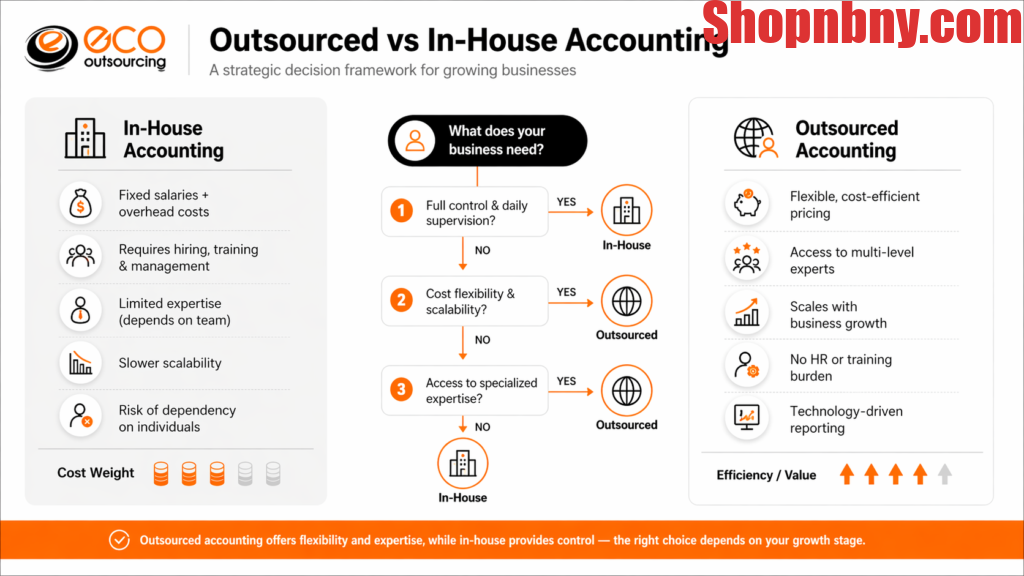
Scalability and Growth Impact
Business growth is rarely linear. You might have six months of steady progress followed by a sudden, massive contract that triples your volume.
- The In-House Bottleneck: When you scale, your in-house accountant gets overwhelmed. You then have to go through the painful, 3-month process of hiring a second person.
- The Outsourced Advantage: A professional firm can scale with you instantly. Need more payroll support? Want to expand into the UAE or EU? They already have the resources and expertise ready to deploy. You don’t “hire”; you simply adjust your service tier.
Risk Security and Trust Factors
“Is my data safe?” is a valid question. In a world of cyber-threats, your financial data is your most sensitive asset.
In-House Risks: Small businesses often have “relaxed” security. A single laptop left on a train or an unencrypted spreadsheet sent via email can lead to a disaster. Furthermore, having only one person in charge of all the money creates a “fraud risk” due to a lack of oversight.
Outsourced Security: Professional firms invest thousands in enterprise-grade security, multi-factor authentication, and encrypted portals. Because they serve multiple clients, they have rigorous internal controls and “four-eyes” checks on every transaction, significantly reducing the risk of human error or internal fraud.
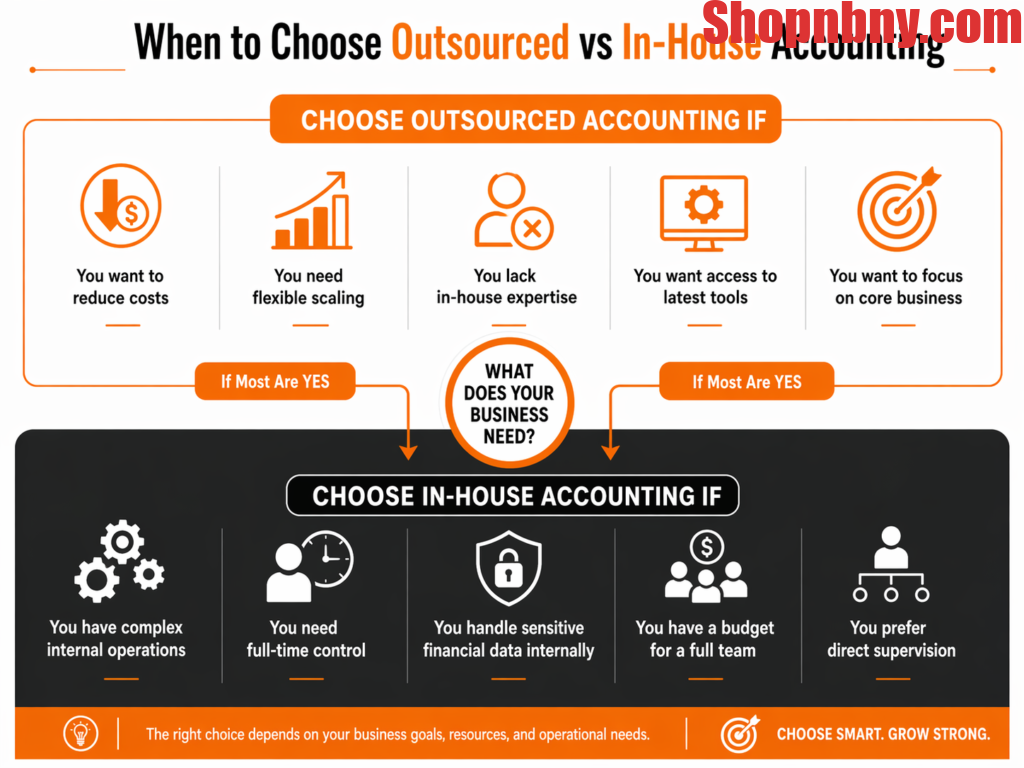
The Decision Framework: Which Is Right for You?
Choose Outsourced Accounting If:
- You are a startup or SME (under £10M turnover) where every pound of overhead counts.
- You need specialized expertise (tax planning, R&D credits, international VAT) that one person can’t provide.
- You are scaling quickly and don’t want to be bogged down by HR and recruitment.
- You value digital-first, real-time visibility over physical presence.
Choose In-House Accounting If:
- Your operations are so complex and stable that you need 40+ hours a week of on-site financial management.
- You have a massive internal team (50+ employees) where a full-time “Finance Director” role is a mechanical necessity.
- You already have a robust management structure to oversee a finance department.
How to Transition Without Disruption?
The fear of a “messy transition” keeps many businesses stuck in outdated models. Here is the 6-step blueprint to a smooth move:
- Audit the Now: Map out your current processes. Who pays the bills? Who runs payroll?
- Define the Scope: Clearly state what you want to move. Start with bookkeeping and payroll, then move to management accounts.
- Clean the Data: Don’t hand over a “mess.” Spend a week tidying up your ledgers.
- Select the Partner: Look for a firm that understands your industry and uses the software you prefer.
- Set the Pulse: Decide how often you will communicate. Weekly check-ins? Monthly strategy calls?
- The 90-Day Rule: Give the new system three months to bed in. The first 30 days are about learning; the next 60 are about optimization.
Common Mistakes to Avoid
- Choosing on Price Alone: Cheap outsourcing is just “remote data entry.” You want a partner, not a typist.
- Ignoring the Onboarding: The first month is critical. If you don’t invest time in the setup, the outputs will be poor.
- Expecting Instant Miracles: It takes time to untangle years of manual bookkeeping. Be patient for the first two cycles.
- Poor Communication: Outsourcing doesn’t mean “abdication.” You still need to be the visionary; they provide the map.
Industry Scenarios: The Right Choice in Context
- The Tech Startup: Needs maximum flexibility. Outsource. Don’t burn venture capital on a full-time CFO too early.
- The Brick-and-Mortar Retailer: Needs tight stock control and daily reconciliations. Outsource to a firm that specializes in retail integrations (Xero + Shopify).
- The Professional Service Firm: Needs high-level tax planning for partners. Outsource to get access to senior tax advisors.
Accounting as a Growth Lever
Too many founders view accounting as a “grudge purchase” something they have to do for HMRC. But when you leverage outsourced accounting services correctly, finance becomes a growth lever.
Imagine having a monthly “Strategy Call” where your accountant tells you: “Your customer acquisition cost is rising, but your lifetime value in this specific segment is 3x higher. If we move 20% of your budget there, your cash flow will improve by 15% next quarter.”
That isn’t “accounting.” That is Decision Intelligence.
Addressing Common Misconceptions
Outsourcing is only for large companies.
False. It is most effective for SMEs who can’t afford a full “C-suite” of financial experts but need their brainpower.
In-house is always more secure.
False. A professional firm’s reputation depends on security. They usually have far better systems than a typical SME office.
You lose visibility.
False. You lose “watching a person sit at a desk,” but you gain a 24/7 digital window into your actual bank balance and profit.
Frequently Asked Questions: Outsourced Accounting vs. In-House Accounting
What is the main difference between outsourced and in-house accounting?
In-house accounting means hiring a dedicated accountant or finance team that works exclusively within your business. Outsourced accounting, on the other hand, means partnering with an external firm or professional who manages your financial functions remotely. The key difference lies in cost, flexibility, and the depth of expertise you gain access to; outsourced firms typically bring a broader skill set at a fraction of the cost of a full-time hire.
Is outsourced accounting suitable for small and medium-sized businesses in the UK?
Absolutely. In fact, outsourced accounting is often the smarter choice for SMEs in the UK. Small and growing businesses rarely need a full-time CFO or accounting team, yet they still require expert financial guidance. Outsourcing allows them to access top-tier financial expertise, stay compliant with HMRC regulations, and manage cash flow effectively all without the burden of salaries, benefits, and office overheads.
How secure is my financial data with an outsourced accounting firm?
Reputable outsourced accounting firms, such as Eco Outsourcing, follow strict data security protocols and confidentiality agreements to protect your sensitive financial information. Most modern firms use encrypted cloud-based systems, ensuring your data is safe, backed up, and accessible only to authorized personnel. Always ensure your provider is transparent about their data handling practices before signing any agreement.
Can outsourced accountants handle UK-specific tax and compliance requirements?
Yes, and this is one of the biggest advantages of outsourcing in the UK. Professional firms operating in the region are well-versed in UK Corporation Tax, VAT regulations, Making Tax Digital (MTD), and Companies House compliance requirements. Rather than relying on a single in-house accountant who may have limited local knowledge, outsourced firms like Eco Outsourcing bring a team of specialists who stay up to date with every regulatory change, keeping your business fully compliant at all times.
At what stage should a business consider switching from outsourced to in-house accounting?
This decision typically depends on the size, complexity, and transaction volume of your business. As a general rule, businesses may consider building an in-house team when they have grown to a scale where daily, on-site financial oversight becomes critical such as managing large payrolls, complex multi-entity structures, or high-volume daily transactions. However, even at this stage, many businesses choose a hybrid model, maintaining an in-house bookkeeper while outsourcing strategic CFO-level functions to an external firm like Eco Outsourcing for expert guidance and cost efficiency.
Conclusion:
There is no “one-size-fits-all” answer, but there is a “right-for-now” answer.
If your goal is to build a lean, agile, and data-driven business, the traditional in-house model is often too slow and too expensive. The transition to outsourced accounting services represents more than just a cost-saving exercise; it is an evolution in how you lead. It’s about moving away from “keeping the books” and moving toward “growing the business.”
That’s where Eco Outsourcing makes all the difference. Designed specifically to support ambitious UK businesses, Eco Outsourcing provides expert financial management, seamless compliance, and strategic CFO-level guidance all tailored to your growth stage. Their dedicated team takes the complexity out of your finances, so you can focus on what truly matters: scaling your business with confidence and clarity.
Align your decision with your growth stage. If you are ready to stop being a “manager of accountants” and start being a “leader of strategy,” the choice becomes very clear. With Eco Outsourcing as your financial partner, you don’t just get an accounting service you gain a growth partner committed to your long-term success.
Disclaimer
This article is for general informational purposes only and does not constitute professional financial, legal, or tax advice. Always consult a qualified professional before making decisions about your accounting structure. Information may not reflect the most current regulations or requirements, and results may vary based on individual business circumstances.














Post Comment