How Isuzu DPF Filter Cleaning Helps Solve Warning Light and Power Loss Problems
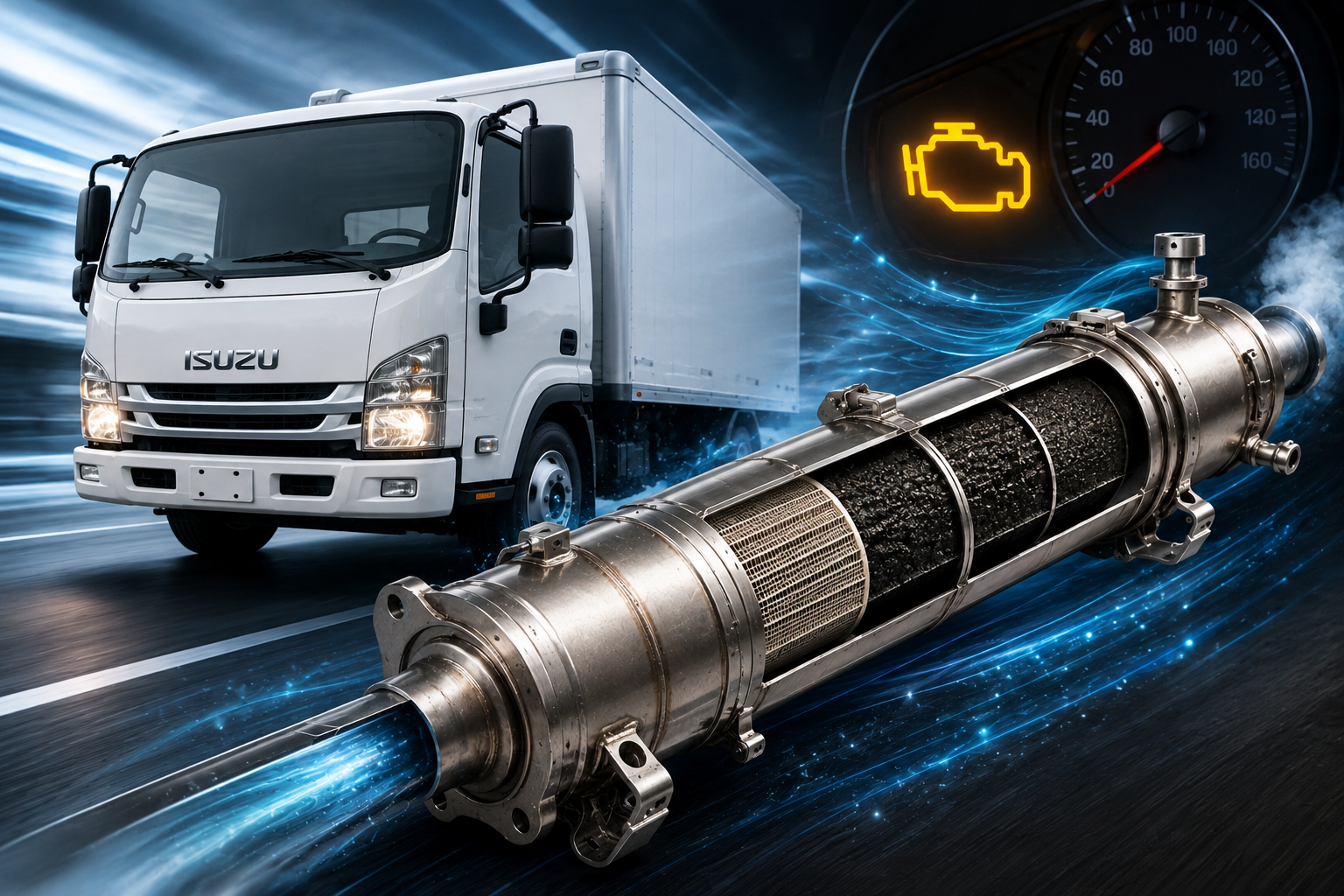
If your Isuzu NPR or other Isuzu diesel truck has been throwing a DPF warning light or suddenly feels sluggish under load, a clogged Isuzu DPF filter is almost certainly the reason. This is one of the most common complaints among Isuzu commercial truck owners, and it is also one of the most misunderstood.
Most drivers assume the worst when that warning light comes on. They start pricing out replacement filters that can run anywhere from $1,500 to $4,000 or more. But in the majority of cases, the filter itself is perfectly fine. It just needs a proper, professional cleaning.
This guide walks you through exactly what happens when your Isuzu DPF filter gets blocked, what warning signs to watch for, how professional cleaning actually solves those problems, and when a replacement genuinely makes sense.
What Is the Isuzu DPF Filter and Why Does It Clog?
The Diesel Particulate Filter, or DPF, is part of the exhaust aftertreatment system on your Isuzu truck. It works by trapping soot particles that come out of the combustion process before they exit through the tailpipe. Without it, your engine would push out black smoke and fail emissions standards.
The DPF does not hold soot forever. It periodically burns off that buildup through a process called regeneration. During active regeneration, exhaust temperatures spike high enough to incinerate the trapped particles and turn them into ash. This is completely normal.
The problem comes when regeneration cannot complete. This happens most often in trucks that do a lot of short city routes, stop-and-go deliveries, or idling. When the engine never gets hot enough for long enough, the soot just keeps stacking up. Eventually the filter becomes so restricted that the engine control module triggers a warning and starts pulling back power to protect itself.
Ash buildup is a separate issue. Unlike soot, ash does not burn away during regeneration. It accumulates over time and can only be removed through mechanical cleaning. This is why even trucks that regenerate perfectly will still need periodic Isuzu DPF filter cleaning.
Warning Signs That Your Isuzu DPF Filter Needs Cleaning
The earlier you catch a DPF problem, the simpler and cheaper the fix. Here are the most common symptoms Isuzu NPR owners report before the situation becomes serious:
- DPF or exhaust filter warning light illuminated on the dashboard
- Noticeable drop in power, especially when going uphill or pulling a load
- Engine going into limp mode or reduced power mode
- Increased fuel consumption without any change in driving habits
- Frequent regeneration cycles or the truck regenerating more often than usual
- Black or excessive smoke from the exhaust
- Rough idle or engine feeling labored at low RPM
- Fault codes related to DPF pressure differential sensors
If you are seeing two or more of these symptoms at the same time, do not ignore them. A partially clogged filter will not heal itself. The soot and ash will continue to build up until the engine goes into full limp mode or the filter sustains heat damage from repeated failed regeneration attempts.
For a broader look at what these symptoms mean across different stages of blockage, check out this detailed resource on clogged DPF filter symptoms before engine damage happens.
How Isuzu NPR DPF Filter Cleaning Actually Works
There is a lot of confusion about what DPF cleaning actually involves. Spraying a chemical additive into your fuel tank is not the same thing as cleaning a clogged filter. Additives can help with mild soot buildup but do nothing for ash accumulation or moderate to severe blockages.
Professional Isuzu NPR DPF filter cleaning involves physically removing the filter from the truck and using specialized equipment to clean it from the inside out. The most effective method currently available is hydraulic cleaning, which uses pulsating water pressure to dislodge and flush out both soot and ash from the filter’s internal honeycomb structure.
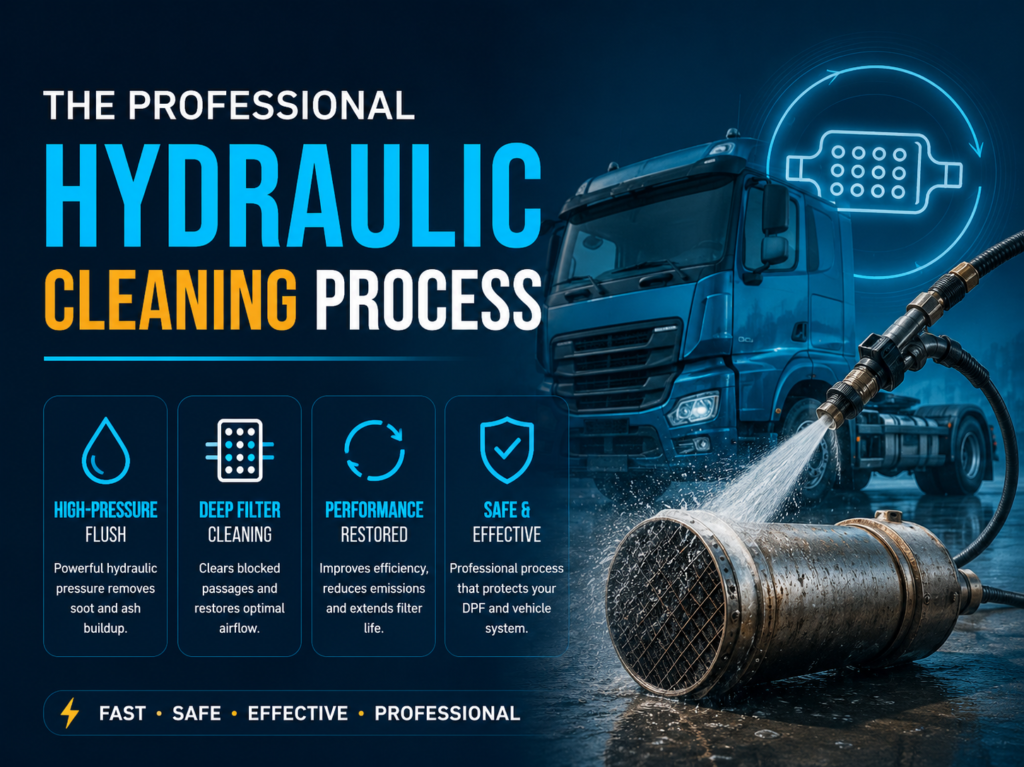
The Professional Hydraulic Cleaning Process
When a DPF comes in for professional cleaning, a trained technician goes through a systematic process:
- The filter is removed and visually inspected for cracks, physical damage, or melted substrate
- Differential pressure testing is done to measure the actual level of blockage before cleaning
- The filter is placed into a hydraulic cleaning machine that circulates cleaning solution through the substrate
- Pulsating water pressure loosens and flushes out soot and ash deposits from both ends
- A drying process removes all moisture from the ceramic substrate
- Post-cleaning differential pressure testing confirms the restriction has been resolved
- The filter is reinstalled and the truck is started to verify no warning lights return
The entire process typically takes 30 minutes to one hour. When done correctly, a professionally cleaned Isuzu DPF filter performs at nearly the same level as a brand new one. Most trucks see an immediate improvement in power and fuel efficiency after the service.
2014 Isuzu NPR DPF Filter: Common Issues and What to Expect
The 2014 Isuzu NPR is one of the most common year models we work on. These trucks are still widely used in delivery fleets, landscaping, construction, and moving companies across the country. At this age, the DPF has usually been through several thousand hours of operation and many regeneration cycles.
By 2014, most Isuzu NPR trucks are running the 5.2L four-cylinder diesel engine with a full aftertreatment system that includes the DPF, a diesel oxidation catalyst (DOC), and in many configurations, a selective catalytic reduction (SCR) system as well.
Common DPF-related fault codes on 2014 Isuzu NPR trucks include codes related to DPF differential pressure, DPF temperature sensor faults, and regeneration failure codes. If the truck has been running short urban routes for most of its life, it may have never properly completed a full active regeneration cycle, meaning ash and soot have been accumulating steadily.
The 2014 Isuzu NPR DPF filter is not cheap to replace. A genuine OEM filter runs $2,000 to $3,500 depending on the supplier. In most cases where the filter is structurally intact and not heat-damaged, professional cleaning is the right call and costs a fraction of that price.
How to Clean DPF Filter on an Isuzu: What You Should Know Before Trying DIY
We get a lot of questions about how to clean DPF filter Isuzu trucks at home. The honest answer is that true DIY cleaning has significant limitations and should only be considered for very mild blockages.
Some of the DIY approaches people try include:
- Forcing a long highway drive to trigger passive or active regeneration
- Using a DPF cleaner additive mixed into the fuel
- Manually flushing the filter with water or compressed air
- Using a scan tool to initiate a forced regeneration cycle
A forced regeneration using a diagnostic tool can work if the filter is only mildly loaded with soot and all the sensors are functional. However, if the soot load is already too high, a forced regen can overheat the filter and cause physical damage to the ceramic substrate. Cracked substrate means the filter cannot be cleaned; it has to be replaced.
Manual flushing with a garden hose or air compressor rarely removes enough ash to make a meaningful difference. The internal structure of a DPF is extremely fine, and without the right equipment and cleaning solutions, you are mostly just pushing material from one section to another.
If you want to understand the full range of Isuzu NPR DPF filter cleaning options and know when each is appropriate, the difference between professional hydraulic cleaning and other methods is significant in terms of results.
You can learn more about the differences between cleaning approaches in this guide onhydraulic DPF cleaning vs. the baking method, which explains why one approach consistently delivers better results.
Isuzu NPR DPF Filter Replacement: When Cleaning Is Not Enough
Cleaning is the right solution in most cases, but not every case. There are situations where Isuzu NPR DPF filter replacement is the correct decision:
- The ceramic substrate has cracked or melted due to thermal damage from failed regenerations
- The filter has physical holes or bypass points that allow unfiltered exhaust to pass through
- The filter has been running with contaminated oil for a long period, causing oil-fouled ash that cannot be removed
- Post-cleaning pressure tests show the filter still does not flow within specification
- The filter has exceeded its expected service life of 200,000 to 300,000 miles in high-cycle applications
Before authorizing a replacement, always ask for a post-cleaning flow test result. If a shop recommends replacement without attempting cleaning first or without presenting test data, get a second opinion. Many shops push replacement because the margin is higher, not because the filter is actually beyond service.
If replacement is genuinely needed, you have the option of purchasing an OEM filter, an aftermarket filter from a reputable brand, or a professionally remanufactured DPF. Each has different price points and warranty terms.

How Often Should You Clean the Isuzu DPF Filter?
The right cleaning interval depends almost entirely on how the truck is used. There is no universal mileage figure that applies to every Isuzu operator.
For trucks primarily used on highway routes where sustained speeds allow for complete passive regeneration, a DPF cleaning interval of 100,000 to 150,000 miles is common. For trucks doing heavy city work, frequent stops, lots of idling, or short hauls, that interval can drop to 50,000 miles or even less.
Watch your regeneration frequency as a real-world indicator. If your truck seems to be regenerating every few hours of operation rather than every few hundred miles, the filter is loading up faster than normal. That is a strong signal that a cleaning is overdue.
The best practice is to schedule a professional inspection at 80,000 to 100,000 miles regardless of symptoms. A differential pressure test can tell you exactly where the filter stands before you have a problem on the road.
What Happens If You Ignore a Clogged Isuzu DPF Filter?
Ignoring the warning signs does not make the problem go away. It makes it significantly worse and considerably more expensive.
When the DPF becomes heavily blocked, the engine has to push exhaust gases through a near-solid restriction. Back pressure increases dramatically. The engine management system enters limp mode, where power is reduced to prevent damage. At this stage, the truck may barely make it to its destination.
Beyond limp mode, continued operation with a severely blocked DPF can cause the engine to attempt repeated high-temperature regenerations to try to clear the blockage. These failed regenerations push exhaust temperatures beyond the DPF’s design limits. The ceramic honeycomb melts or cracks. At that point, the filter is destroyed and cannot be saved by any cleaning method.
Some drivers also experience oil dilution during failed regeneration cycles. Unburned diesel fuel that was injected to raise exhaust temperature ends up in the crankcase instead of combusting. This thins the engine oil, reduces lubrication effectiveness, and can lead to accelerated wear on bearings and cylinder walls.
A cleaning that would have cost a few hundred dollars becomes a filter replacement that costs thousands, potentially alongside engine repairs. The economics are clear.
Get Expert DPF Cleaning Support
If your vehicle is showing signs of a clogged filter, professional cleaning is the most effective way to restore performance. 30 Minute DPF Clean provides reliable solutions designed to keep your engine running smoothly and efficiently. To get started or speak with a specialist, visit our Contact Us page today and schedule your service with confidence.
Frequently Asked Questions About Isuzu DPF Filter Cleaning
Q1: How do I know if my Isuzu NPR DPF filter needs cleaning and not replacement?
A professional shop will perform a differential pressure test before and after cleaning. If the filter flows within manufacturer specification after cleaning, it does not need to be replaced. If cleaning does not restore proper flow, or if physical inspection shows cracks or heat damage to the substrate, replacement becomes necessary. Always ask for test data before agreeing to a replacement.
Q2: How long does a professional Isuzu DPF filter cleaning take?
At a properly equipped facility using hydraulic cleaning equipment, the process typically takes 30 minutes to 1 hour from filter removal to reinstallation. Some shops may take longer depending on the condition of the filter and their equipment. The truck should be operational with a clear warning system on the same day.
Q3: Can I drive my Isuzu NPR with the DPF warning light on?
You can technically continue driving with the light on, but it is not advisable to ignore it for long. The early warning stage usually means the filter is approaching the point where regeneration is becoming ineffective. If the light progresses to a solid warning or the engine enters limp mode, continued operation risks heat damage to the filter itself and potential oil dilution issues in the engine.
Q4: What does Isuzu NPR DPF filter cleaning cost compared to replacement?
Professional cleaning typically runs $300 to $700 depending on the facility and the condition of the filter. OEM replacement filters for the Isuzu NPR range from $1,800 to $3,500 or more. Aftermarket options may be less expensive, but quality varies. In most cases, cleaning a salvageable filter costs 80 to 90 percent less than replacing it.
Q5: Why does my Isuzu keep regenerating so often?
Frequent regeneration cycles usually mean one of two things. Either the truck is doing a lot of short-distance or low-load driving that does not allow passive regeneration to complete, or the filter is getting close to its cleaning interval and soot is loading up faster than it can burn off. If you notice regeneration happening very frequently, have the filter inspected before the situation leads to a limp mode event.
Q6: Is the DPF filter on a 2014 Isuzu NPR the same as newer models?
The 2014 Isuzu NPR uses the 4HK1-TC engine platform with a DPF system that shares design similarities with filters used on later models, but the specific filter dimensions and pressure specifications differ between model years. Always confirm the exact year and engine code when ordering parts or scheduling cleaning to make sure your service provider has the correct specifications for your truck.












Post Comment